|
Thank you, from the BaitShop Boyz! |
Quick Tip for the Week |
Post Reply 
|
Page <1234> |
| Author | |
TasunkaWitko 
Administrator 

aka The Gipper Joined: 10 June 2003 Location: Chinook Montana Status: Offline Points: 14753 |
 Post Options Post Options
 Thanks(0) Thanks(0)
 Quote Reply Quote Reply
 Posted: 08 February 2006 at 06:59 Posted: 08 February 2006 at 06:59 |
|
15 feb 06
Edited by TasunkaWitko |
|
|
TasunkaWitko - Chinook, Montana
 Helfen, Wehren, Heilen Die Wahrheit wird euch frei machen |
|
 |
|
|
TasunkaWitko
Administrator
aka The Gipper Joined: 10 June 2003 Location: Chinook Montana Status: Offline Points: 14753 |
Post Options
Thanks(0)
Quote Reply
Posted: 20 February 2006 at 04:09 |
|
22 feb 06
Edited by TasunkaWitko |
|
|
TasunkaWitko - Chinook, Montana
Helfen, Wehren, Heilen Die Wahrheit wird euch frei machen |
|
|
|
|
TasunkaWitko
Administrator
aka The Gipper Joined: 10 June 2003 Location: Chinook Montana Status: Offline Points: 14753 |
Post Options
Thanks(0)
Quote Reply
Posted: 22 February 2006 at 07:07 |
|
i march 2006
-----------------------------------
Always use a steel leader when fishing for Esocids, which include Edited by TasunkaWitko |
|
|
TasunkaWitko - Chinook, Montana
Helfen, Wehren, Heilen Die Wahrheit wird euch frei machen |
|
|
|
|
TasunkaWitko
Administrator
aka The Gipper Joined: 10 June 2003 Location: Chinook Montana Status: Offline Points: 14753 |
Post Options
Thanks(0)
Quote Reply
Posted: 02 March 2006 at 07:09 |
|
8 mar 06
-------------------------- Corning Big Game: Corning is a method of meat preservation developed in the days before refrigeration. After butchering a steer, a farmer would cure the brisket or some other tough cut in a salt/sugar brine for several weeks. The salt acted as a preservative, and the sugar developed flavor and tenderness. Meat cured this way was called “corned” because the salt pellets were about the size of corn kernels. On a moose or elk, the brisket, or thin meat that covers the bottom of the rib cage, is thick enough for corning. On smaller animals like antelope and deer, it may be too thin. A rolled, boneless shoulder roast will work well; flank meat, which lies between the last rib and hindquarter, is also a good choice. The corning method below requires two types of salt. Canning and pickling salt is pure salt, without any iodine or free-flowing agents, which might adversely affect the texture of the meat. Tenderizing salt is a mixture of salt, sugar and preservatives. It adds flavor and tenderness, and the preservatives give the meat its characteristic pink color. To make corned venison, follow this method: • 2 to 3-pound brisket, flank or shoulder roast up to 1 inch thick. • 2 quarts spring water or distilled water • 1/2 cup canning and pickling salt • 1/2 cup tenderizing salt (e.g. Morton’s TenderQuick) • 3 Tbs. sugar • 2 Tbs. mixed pickling spice • 2 bay leaves • 8 whole, black peppercorns • 1 or 2 cloves garlic, minced Roll brisket, flank or shoulder loosely and tie. Place in large glass or pottery mixing bowl, or in large oven cooking bag. In large glass or enamel saucepan, combine remaining ingredients. Heat just to boiling, then remove from heat and cool. Pour cooled brine over meat. Cover bowl with plastic wrap; or, if using oven cooking bag, squeeze to remove air, then twist neck of bag and seal. Refrigerate 4 to 5 days, turning meat occasionally. Drain and rinse meat with cold water. |
|
|
TasunkaWitko - Chinook, Montana
Helfen, Wehren, Heilen Die Wahrheit wird euch frei machen |
|
|
|
|
TasunkaWitko
Administrator
aka The Gipper Joined: 10 June 2003 Location: Chinook Montana Status: Offline Points: 14753 |
Post Options
Thanks(0)
Quote Reply
Posted: 08 March 2006 at 07:55 |
|
15 march 06
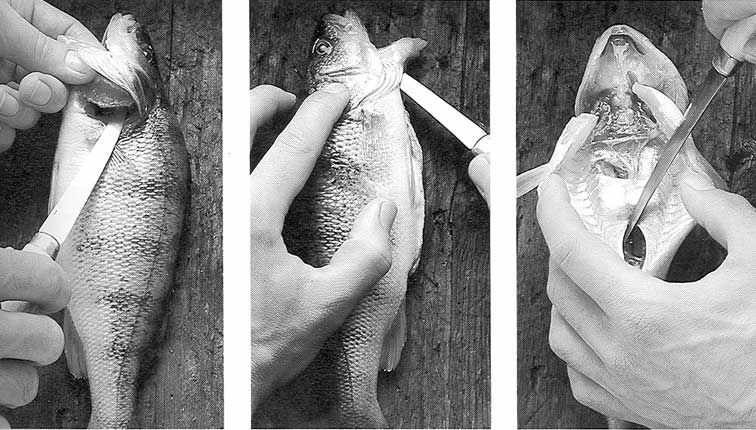
------------------------------- If you are out at the lake or on the ice and the fishing is especially good, you might run out of bait. The way perch steal bait, you can spend more time baiting your hook than fishing. Two common fish, walleyes and perch, bring their own bait with them. Try tipping jigs or hooks with these natural baits, which can be used on the lake or frozen for later use: 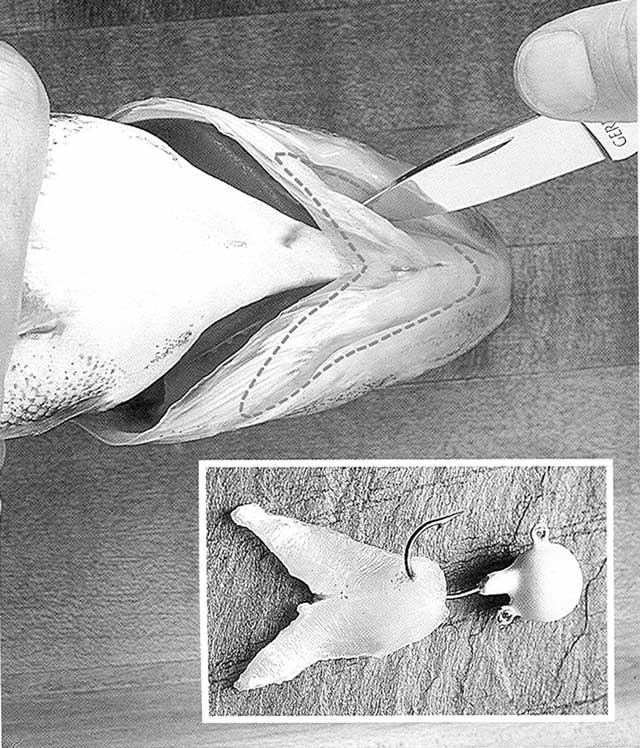 Cut the throat tissue out of a walleye by slicing along the dotted lines as shown. Then cut the tissue loose at the point of the chin. Drive the hook through the front of the piece of throat tissue. The meat is thicker and tougher, so the hook won’t tear out. The thin flesh wiggles enticingly, emits natural scent and is remarkably durable. 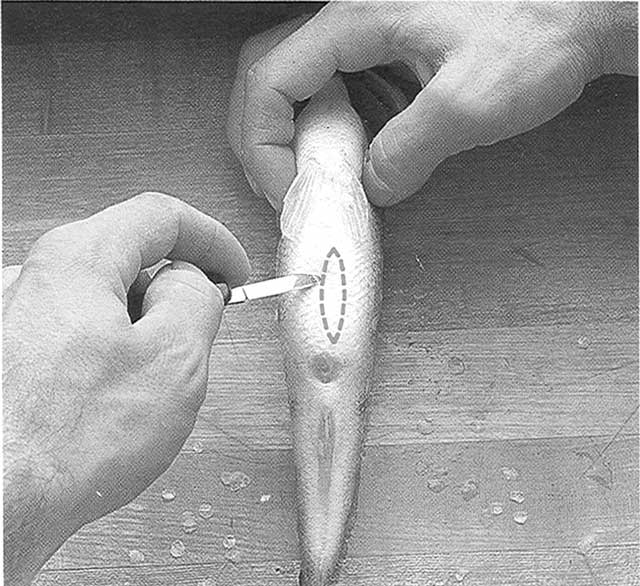 Scale the belly of a small perch and cut out an inch-long strip (dotted lines). Split one end of the strip to form two tails. Hook the other end on the jog or hook. This bait attracts fish with smell, taste and action. Edited by TasunkaWitko |
|
|
TasunkaWitko - Chinook, Montana
Helfen, Wehren, Heilen Die Wahrheit wird euch frei machen |
|
|
|
|
TasunkaWitko
Administrator
aka The Gipper Joined: 10 June 2003 Location: Chinook Montana Status: Offline Points: 14753 |
Post Options
Thanks(0)
Quote Reply
Posted: 15 March 2006 at 09:15 |
|
22 mar 06
--------------------- Nearly all of the tips and recipes that are printed in this column come from one of two sources. The first is my website, www.baitshopboyz.com, which I started back in 2001. Over the last five years, the BaitShop has grown into an outstanding web community of sportsmen dedicated to hunting, fishing, shooting, camping, conservation and generally anything to do with the outdoors. More than 550 members from every corner of the United States as well as Canada, Australia, New Zealand and other countries meet at the BaitShop to swap information, stories and good times. If you would like to tap into this wealth of information, or simply shoot the breeze with a group of fellow sportsmen, take a look at this website. This web service is totally, 100% free of charge; all you need is a computer. Check it out. A second source that I rely on very heavily is a series of books called The Hunting and Fishing Library. Originally published by Cy DeCosse Publishing, the series went on to be published by Cowles Creative Publishing. To my knowledge, the original series is now out of print, but books can still be found in bookstores and on the Internet; I have also seen some copies at K-Mart, Wal-Mart and Shop-Ko. Two very good Internet sources for these books are amazon.com and ebay.com, where these books can be purchased for a very reasonable price. Some of the titles in the series include: The Art of Freshwater Fishing, Cleaning and Cooking Fish, Fishing Rivers and Streams, Walleye, Northern Pike and Muskie, Fishing with Natural Bait, Fishing with Artificial Lures, Fishing Tips and Tricks, the Art of Hunting, Dressing and Cooking Wild Game, Mule Deer, Elk, Pronghorn and Upland Game Birds. This is just a small sampling of titles. I highly recommend this series to anyone interested in reading about hunting or fishing. As always, I welcome and encourage anyone out there to submit recipes or tips. They can be sent to me by email at bcj_fischer@yahoo.com or mailed to Ron Fischer, C/O The Blaine County Journal, POB 279, Chinook, Montana 59523. Also, if anyone would like to see any specific recipes printed or has specific questions about the outdoors sports, please let me know. I’ll do my best to accommodate your request! |
|
|
TasunkaWitko - Chinook, Montana
Helfen, Wehren, Heilen Die Wahrheit wird euch frei machen |
|
|
|
|
TasunkaWitko
Administrator
aka The Gipper Joined: 10 June 2003 Location: Chinook Montana Status: Offline Points: 14753 |
Post Options
Thanks(0)
Quote Reply
Posted: 23 March 2006 at 07:57 |
|
Look for early-season walleyes on rock piles in water less than 10 feet Bays are obvious spots to check, but another type of spot that isn’t so Edited by TasunkaWitko |
|
|
TasunkaWitko - Chinook, Montana
Helfen, Wehren, Heilen Die Wahrheit wird euch frei machen |
|
|
|
|
TasunkaWitko
Administrator
aka The Gipper Joined: 10 June 2003 Location: Chinook Montana Status: Offline Points: 14753 |
Post Options
Thanks(0)
Quote Reply
Posted: 30 March 2006 at 06:15 |
|
5 apr 06
Edited by TasunkaWitko |
|
|
TasunkaWitko - Chinook, Montana
Helfen, Wehren, Heilen Die Wahrheit wird euch frei machen |
|
|
|
|
TasunkaWitko
Administrator
aka The Gipper Joined: 10 June 2003 Location: Chinook Montana Status: Offline Points: 14753 |
Post Options
Thanks(0)
Quote Reply
Posted: 06 April 2006 at 07:57 |
|
12 apr 06
There’s no disputing the concept of catch-and-release fishing, but unless fishermen know exactly how to release their fish, many will die from mishandling. If you follow these procedures, the fish you release will have an excellent chance of survival. • Flatten barbs on hook so that they can be removed without injuring the fish. By keeping a tight line during the fight, you will seldom lose a fish. • When playing a fish on a river or stream, move to a location out of the current. This way, it cannot use the current to its advantage, and tires more quickly. • Leave the fish in the water, grasp the hook with a pliers or hemostat, then shake the hook to release the fish. This way, you won’t remove the fish’s protective slime, which protects it from infection. Do not squeeze or touch the gills. • Cut the leader if a fish is deeply hooked. In a Wisconsin study, 56% of deep-hooked fish survived when the leader was cut; only 11% survived when the hook was removed. • Hold the fish in an upright position facing into the current. Give it time to recover so it can swim away on its own. If it starts to sink, hold it upright a little while longer. • After an especially long battle, the fish might need a little help gaining its energy back. Hold the fish in the water and gently move the fish back and forth in the water to get water running through the gills, the fish will scoot when it is ready. Above all, do everything you can to minimize stress and fatigue for the fish. Play it quickly, keep it in the water and handle the fish as little as possible. |
|
|
TasunkaWitko - Chinook, Montana
Helfen, Wehren, Heilen Die Wahrheit wird euch frei machen |
|
|
|
|
TasunkaWitko
Administrator
aka The Gipper Joined: 10 June 2003 Location: Chinook Montana Status: Offline Points: 14753 |
Post Options
Thanks(0)
Quote Reply
Posted: 13 April 2006 at 06:40 |
|
19 apr 06
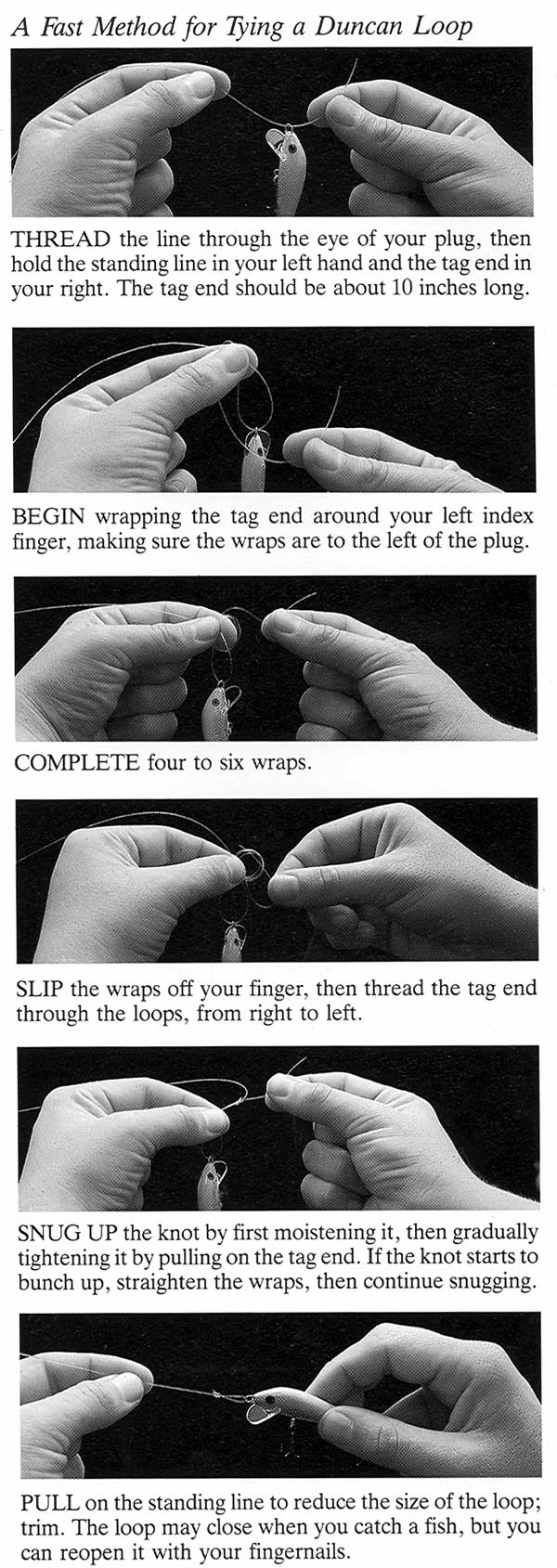
--------------------------------------------------- Crankbaits, plugs and “Rapala”-style minnows will catch practically any kind of gamefish except the smallest panfish species. The key to fishing these types of lures is to know that they run at different depths and are most effective within their “optimum” depth. For instance, if you’re fishing in 8 feet of water, you’ll probably want a lure that runs 6 or 7 feet deep. To determine how deep a crankbait tracks, retrieve the lure through water of a known depth, feeling for it to touch the bottom. If it does, move to slightly deeper water and try again. Continue until the lure no longer touches and note the depth. To help you remember how deep your crankbait runs, write the running depth of each lure on the body or lip with an indelible marker so you know at a glance which crankbait to use. Running depths are often listed in catalogs or the instructions that come with the lures, but it’s best to test them yourself. Different line weights and retrieve speeds will cause the lures to run at different depths. A crankbait will not attain maximum depth unless tuned so that it tracks perfectly straight. Depending on the type of lip, a crankbait must be tuned by bending or twisting the eye, bending the lip itself or bending the attachment wire. To reach maximum depth, cast as far as possible and keep your rod tip low while retrieving. With a shorter cast or higher rod position, you will begin pulling the plug upward before it reaches its potential depth. As noted before, line diameter also affects depth. Thin line has less water resistance and allows the plug to run deeper than thick line. The smaller the plug, the more it is affected by line diameter. 6- to 12-pound mono is usually sufficient for most fishing, but for heavy cover or big fish, strength up to 25-pound test may be necessary. For the best action, tie a crankbait directly to the line. If the plug does not have a split ring on the eye, install one or use a Duncan loop (demonstrated a couple of weeks ago; if you need a copy, email me). A heavy leader or snap-swivel will restrict the plug’s wobble. To keep your lure in the “fish zone” as long as possible, cast parallel to the structure or cover. For example, to work the shady side of a log, cast parallel to the log and retrieve the lure along its length. If you cast perpendicular to a log, your lure will be in the fish zone only a fraction of the time. Edited by TasunkaWitko |
|
|
TasunkaWitko - Chinook, Montana
Helfen, Wehren, Heilen Die Wahrheit wird euch frei machen |
|
|
|
|
TasunkaWitko
Administrator
aka The Gipper Joined: 10 June 2003 Location: Chinook Montana Status: Offline Points: 14753 |
Post Options
Thanks(0)
Quote Reply
Posted: 21 April 2006 at 07:29 |
|
For top quality flavor, all fish should be field dressed as quickly as
Edited by TasunkaWitko |
|
|
TasunkaWitko - Chinook, Montana
Helfen, Wehren, Heilen Die Wahrheit wird euch frei machen |
|
|
|
|
TasunkaWitko
Administrator
aka The Gipper Joined: 10 June 2003 Location: Chinook Montana Status: Offline Points: 14753 |
Post Options
Thanks(0)
Quote Reply
Posted: 28 April 2006 at 12:22 |
|
3 may 06 ------------------------------- Some fish recipes for cooking larger fish call for the fish to be "butterflied." This procedure keeps the fish whole while making it boneless. To do this, use the instructions and pictures below as a guide. Start with a whole, drawn fish such as a lake trout or walleye. Cut from inside cavity along each side of backbone to release bone from fish (Left). Do not cut through skin. Discard bone and spread out two sides of fish so it lies flat (Right). Trim fat and discard belly meat. Remove rib bones.
"Butterflying" also refers to a preparation method that is a fast and appealing alternative to steaking larger, smooth-skinned fish such as large trout, salmon or catfish.
Normally, these fish are "steaked," which means that they are cut into sections through the backbone along the ribs. When butterflying them, however, you don’t cut through the heavy backbone, so your knife stays sharp. The finished cut is also easier to eat than a steak because it has no bones. Finally, butterflied fillets are more appealing because the meat is on the outside, with the skin and fat tucked away on the inside. To butterfly fillets:
Cut a (1) fillet from the fish. Remove the rib bones, but don’t skin the fillet. (2) Slice across the fillet, about an inch from the end, cutting through the meat but not the skin. (3) Make a second cut, parallel to the first and about an inch farther from the end; slice completely through both the meat and the skin. (4) Fold the piece of fish backwards along the first cut so the meat is on the outside and the skin is on the inside. Butterfly the rest of the fillet, except the tail section. |
|
|
TasunkaWitko - Chinook, Montana
Helfen, Wehren, Heilen Die Wahrheit wird euch frei machen |
|
|
|
|
TasunkaWitko
Administrator
aka The Gipper Joined: 10 June 2003 Location: Chinook Montana Status: Offline Points: 14753 |
Post Options
Thanks(0)
Quote Reply
Posted: 04 May 2006 at 08:25 |
|
10 may 06
------------------------------- The fillets of many kinds of fish contain a row of small bones, called
Remove the row of bones after first locating it with your finger. Slice through the fillet along one side of the bones for the length of the body cavity. Then slice along the other side, forming a thin strip (dotted line) that you can lift out, leaving a completely boneless fillet.
Members of the pike family have delicious, flaky meat; but the Y-bones (above) are bothersome enough that some people refuse to eat these fish. Although there are a couple of ways to remove these bones, most fishermen don’t know how, so they are forced to pick them out at the table. Here’s one easy way to make boneless fillets from pike and pickerel. Then you can forget about Y-bones and enjoy your meal.
Cut down behind the head. Turn the blade toward the tail and run it along the backbone (dotted line). Slice upward just ahead of the dorsal fin, cutting away the back fillet.
Loosen the skin along the edge of the back fillet so it will lie flat on the cutting surface. Now you can skin the fillet as you would any other.
Remove the side fillets by first cutting down to the backbone, once behind the head, and a second time ahead of the dorsal fin (arrows). Feel along the back to find the Y-bones (row of dots). With the fish on its side, insert your knife just above the Y-bones and cut away a fillet (shown) so the Y-bones remain attached to the fish. Remove the fillet from the other side in the same way. Skin the fillets.
Cut off the fillets from each side of the tail section by slicing along the backbone. There are no Y-bones in this part of the fish. Skin the tail fillets. You now have five boneless fillets. Edited by TasunkaWitko |
|
|
TasunkaWitko - Chinook, Montana
Helfen, Wehren, Heilen Die Wahrheit wird euch frei machen |
|
|
|
|
TasunkaWitko
Administrator
aka The Gipper Joined: 10 June 2003 Location: Chinook Montana Status: Offline Points: 14753 |
Post Options
Thanks(0)
Quote Reply
Posted: 12 May 2006 at 08:54 |
|
17 may 06
Edited by TasunkaWitko |
|
|
TasunkaWitko - Chinook, Montana
Helfen, Wehren, Heilen Die Wahrheit wird euch frei machen |
|
|
|
|
TasunkaWitko
Administrator
aka The Gipper Joined: 10 June 2003 Location: Chinook Montana Status: Offline Points: 14753 |
Post Options
Thanks(0)
Quote Reply
Posted: 17 May 2006 at 06:12 |
|
24 may 06
------------------------------ Most minnow plugs are either floating or sinking. A standard floating minnow plug must be retrieved at moderate speed to prevent it from rising quickly to the surface. Sinking plugs require similar retrieval in order to keep from sinking into the depths. This means that both styles are somewhat limited in their useful applications. There is a third option: the neutrally buoyant plug. This plug will stay suspended in the water without rising to the top or sinking to the bottom. A neutrally buoyant plug can be retrieved much more slowly than floating or sinking plugs, yet it will maintain its depth. Slower retrieves often work better in cool water or when fish are sluggish. It is easy for fishermen to doctor their floating minnow plugs to make them neutrally buoyant: 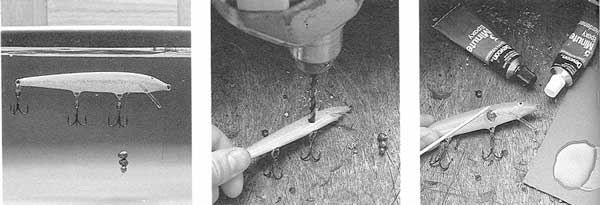 1. Slip a mono noose over the plug, then pinch on enough shot so the lure barely sinks and remains suspended in a tub of water. Move the noose forward or backward to find the balance point. 2. Drill a hole large enough for the shot just below the center line and directly in line with the position of the noose. 3. Center the shot in the hole, otherwise the plug will tip to one side in the water. Seal both ends of the hole with epoxy glue. Edited by TasunkaWitko |
|
|
TasunkaWitko - Chinook, Montana
Helfen, Wehren, Heilen Die Wahrheit wird euch frei machen |
|
|
|
|
TasunkaWitko
Administrator
aka The Gipper Joined: 10 June 2003 Location: Chinook Montana Status: Offline Points: 14753 |
Post Options
Thanks(0)
Quote Reply
Posted: 01 June 2006 at 09:56 |
|
31 may 06
------------------------------------------------------------ ---------------
Most plugs, spoons and spinners come with treble hooks, but if you’re after trophy-class fish, ordinary trebles may not be strong enough. Big-fish specialists know that a good-sized single hook will sink deeper and hold better than a treble, and no fish is likely to bend or break it. If you’re fishing in waters where there’s a good chance of hooking something big, replace your trebles with a single Siwash hook. A Siwash has a sturdy shank and an extra-long, low-tapering point that penetrates like a needle. Once a fish is on, there is little chance that it will get away. Lures with a Siwash hook offer another advantage: they can be used in waters where treble hooks are banned.
If the trebles are attached with split rings, you can simply open the ring, take off the treble and substitute the Siwash. If the ring is welded, you’ll have to cut it off and add a new one. If a lure has two or three trebles, you may want to remove all of them and add just one Siwash where the rear treble was. Edited by TasunkaWitko |
|
|
TasunkaWitko - Chinook, Montana
Helfen, Wehren, Heilen Die Wahrheit wird euch frei machen |
|
|
|
|
TasunkaWitko
Administrator
aka The Gipper Joined: 10 June 2003 Location: Chinook Montana Status: Offline Points: 14753 |
Post Options
Thanks(0)
Quote Reply
Posted: 01 June 2006 at 09:59 |
|
7 jun 06 ----------------------------------------
It’s widely believed that the best way to set the hook on a fish is to jerk the rod as hard as you can and “cross their eyes.” A solid hook set will catch more fish, but there’s a better way to sink the hooks than jerking wildly, especially if you’re using monofilament line. If you have any slack at all in your line, a fast jerk of the rod will exert practically no force at the end of the line. If you find this hard to believe, try the following experiment. Tie a swivel to your line and have someone squeeze it between his fingers. With the rod in your hand, back off about 50 feet. Let out a little extra line and then jerk as hard as you can. Chances are you won’t pull the swivel from your partner’s fingers. Because of the slack and the stretch of the monofilament, surprisingly little force is transmitted. Here’s a better way to get a powerful hook set. When you feel a bite, point your rod at the fish and immediately reel up slack until you feel weight. Then, set the hook with a quick snap of the wrists. Although this hook-setting method is much less spectacular, it transmits considerably more force for driving in the hook. Edited by TasunkaWitko |
|
|
TasunkaWitko - Chinook, Montana
Helfen, Wehren, Heilen Die Wahrheit wird euch frei machen |
|
|
|
|
TasunkaWitko
Administrator
aka The Gipper Joined: 10 June 2003 Location: Chinook Montana Status: Offline Points: 14753 |
Post Options
Thanks(0)
Quote Reply
Posted: 07 June 2006 at 07:12 |
|
14 jun 06
------------------------- Many people do not associate outdoor grilling with fish, but the fact is that grilled fish has the same delicious, charred-wood flavor as other grilled meats. Oily fish, such as trout and salmon, are best suited to grilling because they stay moist despite the high-heat cooking process. Lean fish, such as walleye or largemouth bass, tend to get dry unless you select thick cuts. You can grill steaks, fillets or whole fish. On the average, fish should cook for 10 minutes per inch of thickness. Any fish can be grilled, but many freshwater species such as crappie and walleye have delicate meat that breaks up easily and falls through the grate. Always grill these fish in a grilling basket or on a grilling screen or piece of aluminum foil. Fillets or steaks from firm-textured fish such as northern pike and trout can be placed directly on a well-oiled grill. If you place a skin-on fillet or whole fish directly on the grate, the skin may stick. An oil-based marinade not only adds flavor to grilled fish, but also prevents lean fish from drying out and reduces the chance that the meat will stick. Coat he fish with marinade before cooking and baste frequently during the cooking process. Other tips for grilling fish: • Remove hardened grease from your grate with a foaming-type oven cleaner. Keep the grate clean by washing frequently in soapy water. Spray the grate with nonstick vegetable cooking spray after cleaning it thoroughly with a stiff wire brush or coarse steel wool and rinsing it with water. Do not spray the grate over hot coals – the spray may ignite. • Close the lid and adjust the vents to regulate the heat of the grill. You can also increase the heat by lowering the grate or bunching the coals more closely. You can reduce the heat by raising the grate or spreading the coals. • Turn the fish after half the cooking time, using a long-handled spatula. Total cooking time depends on air temperature and wind strength, but seldom exceeds 10 minutes per inch of thickness. Edited by TasunkaWitko |
|
|
TasunkaWitko - Chinook, Montana
Helfen, Wehren, Heilen Die Wahrheit wird euch frei machen |
|
|
|
|
TasunkaWitko
Administrator
aka The Gipper Joined: 10 June 2003 Location: Chinook Montana Status: Offline Points: 14753 |
Post Options
Thanks(0)
Quote Reply
Posted: 19 June 2006 at 19:40 |
|
21 jun 06
------------------------------------------------------------ --------------
All knots weaken line; the best have little effect on line strength, while the worst cut strength in half. Two favorites, the clinch knot and the improved clinch, are not recommended, because few fishermen tie them consistently well. As a result, these knots often have sharp bends that fracture under stress. Choose knots that are easy to tie correctly, because even the strongest knot is weak if not properly tied.
The Trilene knot is unusually strong. It is rated at 90% of the line strength, compared to an average of about 75% for other fishing knots such as the clinch knot. Here are a few tips for tying knots:
· Moisten the knot with saliva before snugging it up. This reduces friction and helps to form a knot that is smooth and tight.
· Snug up the knot with a smooth, strong pull. Do not be timid about testing it. Better that it breaks while being tied than after hooking a big fish!
· Clip the tag end of the line carefully, being sure not to nick the knot. It pays to leave a little extra line, because all knots slip slightly just before they break.
· Knots weaken with use. Good fishermen tie new knots before a trip and test their knots frequently.
There are many, many knots available for anglers. As mentioned before, the Trilene knot is one of the strongest and most versatile. Below are instructions for tying the Trilene knot:
Edited by TasunkaWitko |
|
|
TasunkaWitko - Chinook, Montana
Helfen, Wehren, Heilen Die Wahrheit wird euch frei machen |
|
|
|
|
TasunkaWitko
Administrator
aka The Gipper Joined: 10 June 2003 Location: Chinook Montana Status: Offline Points: 14753 |
Post Options
Thanks(0)
Quote Reply
Posted: 22 June 2006 at 06:36 |
|
Fishermen catch plenty of good-sized northern pike in the shallow,
weedy bays during the spring, but when the water warms up, they get nothing but “hammer handles” in these areas. The lack of big pike in the summer has led to the mistaken belief among some anglers that pike lose their teeth or have sore mouths this time of year and don’t feed. The truth is, however, that they are feeding more than ever. The main reason for the scarcity of big pike in summer is that anglers aren’t fishing deep enough. As pike get larger, they prefer cooler water. In some cases, they will congregate around spring holes, artesian wells, the mouths of trout streams or other specific point sources of cold water; however, if there are no point sources, pike have no choice but to go deep. If there is adequate oxygen in the lake depths, they’ll go as deep as 50 feet and occasionally down to 100. Lake trout anglers sometimes catch big pike. At these depths, they’re generally feeding on good sized baitfish, such as whitefish or ciscoes, and you’ll have to use similar-sized baitfish to catch them. A good rule of thumb is to use a baitfish that is about one-fourth the length of this northern you plan to catch; thus, you would use an 9-inch baitfish to catch a 36-inch northern, and so on. |
|
|
TasunkaWitko - Chinook, Montana
Helfen, Wehren, Heilen Die Wahrheit wird euch frei machen |
|
|
|
|
Post Reply
|
Page <1234> |
 Tweet
Tweet
|
| Forum Jump | Forum Permissions You cannot post new topics in this forum You cannot reply to topics in this forum You cannot delete your posts in this forum You cannot edit your posts in this forum You cannot create polls in this forum You cannot vote in polls in this forum |


 Topic Options