|
Thank you, from the BaitShop Boyz! |
as long as the waters shall flow |
Post Reply 
|
| Author | ||||||
TasunkaWitko 
Administrator 

aka The Gipper Joined: 10 June 2003 Location: Chinook Montana Status: Offline Points: 14753 |
 Post Options Post Options
 Thanks(0) Thanks(0)
 Quote Reply Quote Reply
 Topic: as long as the waters shall flow Topic: as long as the waters shall flowPosted: 17 January 2006 at 13:44 |
|||||
|
As Long As The waters Shall Flow
By Ronald Fischer bcj_fischer@yahoo.com Much of the historical and technical information for this article was provided by Dean Stiffarm, Sr., Environmental Liaison for the Fort Belknap Tribal Community. BCJ would like to thank Mr. Stiffarm for providing this information, and encourages anyone requiring more information to contact him at RR 1, Box 66, Fort Belknap Agency, Harlem, Montana 59526. He may also be reached by phone at 406.353.8411 or by email at stiffarm_dean@hotmail.com.
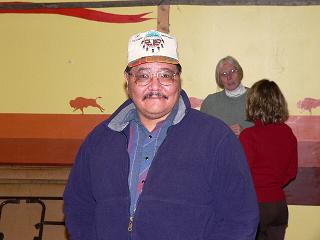
Dean Stiffarm, Environmental Liaison for the Fort Belknap Tribal Environmental Department The Montana Board of Environmental Review met on Wednesday, January 11th at the Bingo Hall in Fort Belknap to decide on extending the comment period for a proposed rule that would quicken the cleanup of water contaminated by Pegasus Mining at the Zortman and Landusky mines. The decision itself was rather easy to make; there was little-to-no opposition and much support, and the board ultimately chose to extend the comment period on the rule. The issues raised at this hearing, however, were of great importance. The concerns go back to the Grinnell "Agreement" of 1895, in which a large portion of the Fort Belknap Reservation was ceded to the United States for $360,000 for the purposes of mining gold. The gold was discovered due to illegal trespassing onto tribal lands and the agreement was reached under heavy pressure from the government and the interests that wanted to exploit the resource. The tribes were well aware what had happened to the Lakota after gold had been discovered in the Black Hills due to similar illegal trespassing on the Great Sioux Reservation, and had no real option but to take what was offered to them.
During the negotiations for this agreement, the United States agreed not to compromise the water rights of the tribes in any way, and promised that the tribes would retain enough water for present and future use. This commitment to tribal water rights was underscored in the Winter Doctrine of 1908, when the Supreme Court of the United States ruled that the establishment of the reservation twenty years before gave the tribes unspecified amounts of water that they needed to modernize their land use practices and economy. Tribal members left the Grinnell negotiations with the understanding that they were granting only mineral rights to mine the gold in the mountains. It wasn’t until several years later that they learned that a significant portion of the Little Rocky Mountains had actually been removed from the reservation.
This satellite photo shows the portions of land removed by the Grinnell Agreement of 1895. The agreement effectively gave the Little Rocky Mountains (and the gold within) away for $360,000. With the signing of the Grinnell Agreement, the illegal mining which had been going on for years was suddenly legal, and for over 90 years underground mining resulted in workings and tailings that were deposited directly into stream channels. In 1979, the exploitation took on a colossal scale when Pegasus Gold began operations on the Zortman and Landusky mines using a new method called "heap leach" operations. The purpose of heap-leach mining was to extract microscopic amounts of gold from bodies or that were considered to be too poor to produce gold at a profit. The practice of heap-leach mining was to tear up a mountainside into giant heaps, then pour cyanide solutions over the heaps to leach out the gold. The result was literally earth shaking; Pegasus managed to rip up entire mountains and reduce them to broken, poisoned debris. The most dramatic effect was that Spirit Mountain, which had been sacred to the tribes as long as they had been in the area, was destroyed. A mountain that stood from the beginning of time was reduced to rubble, and the exposed rocks turned olive-green and began to leak acid into the water, which ran directly onto tribal lands and into the water supplies of the people living there.
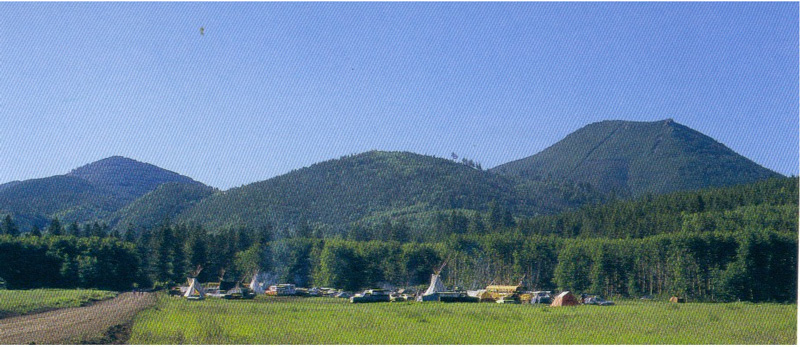
This picture shows how the skyline used to look before 1979. Spirit Mountain is on the left in this picture, but is now entirely gone.
The same skyline now. Note the left side.
This is all that is left of Spirit Mountain, a place that has been sacred to the tribes for generations. Though it is now illegal, heap-leach mining was new at the time, and the impact to the environment was either not understood or swept under the rug. In 1998, Pegasus Gold went bankrupt (only to recently re-emerge as Apollo Gold). The former owners of Pegasus posted bond money financing the treatment of polluted water; however, this fund will run out in 2018, while the need for treatment is expected to exist for an estimated hundred years. This shortfall was confronted in 2005 when State Representative Jonathan Windy Boy spearheaded House Bill 379, which was signed into law by Governor Brian Schweitzer. The bill endorsed a means of financing the permanent water treatment operation beginning in 2018, when the Pegasus money runs out. About 1.2 million per year will be deposited into an account which is expected to reach $19 million by the time interest earnings must be tapped for the water treatment at the Zortman and Landusky mines.
The Zortman Mine operated between 1979 and 1998.
The Landusky Mine operated between 1979 and 1998. While the cleanup of the mines themselves seems to be taken care of – to the extent that the destruction of mountains can be taken care of – the discharging of polluted water continues. Swift Gulch Creek and other waters that run directly into tribal water supplies run reddish brown, and animals that drink from it along poisoned, bare creek banks become deformed and die from the chemicals in the water. While there is a state DEQ system in place for dealing with this, called the Montana Pollution Discharge Elimination System (MPDES), the permits have not yet been issued. Further, the United States Bureau of Land Management in 2004 declared the operations a Superfund site due to the threat of public health and welfare or the environment from ongoing pollution occurring on the mine sites.
Swift Gulch Creek is just one of many sites where the contamination has poisoned the water. While the color makes it look bad, the real danger is found within the chemical properties of the water. With big business, state government, environmental groups, tribal agencies and Federal bureaus involved, action was necessary. The Montana Board of Environmental Review was petitioned last year by the Fort Belknap Indian Community Council and the Montana Environmental Information Center to amend its rules promulgated under the authority of the Metal Mine Reclamation Act to require compliance with water quality standards within two years of mining operations. The intent is to prevent what happened in the Little Rocky Mountains from happening anywhere else in Montana. There really is no opposition to this amendment; Wayne Jepson, manager of the Zortman project at the Montana DEQ has stated, "Zortman-Landusky became one of the worst cases in Montana." In the early 1990’s an EPA consultant and former mining engineer, Orville Klein, warned in a memo to his bosses that not enough money was being set aside by the mine for water treatment. There is general agreement all around that this is a flat-out worst-case scenario, and an example of what mining companies should not do on nearly all fronts.
This satellite photo shows the proximity of Hays and Lodgepole to the Zortman and Landusky mines. The towns are under a direct threat from contamination that is carried by wind and water. The board will also consider re-wording the rule, a change that was proposed by MEIC water and mining program director Jeff Barber. Under the current proposal, mining companies would have to "conclusively demonstrate" that perpetual water treatment would not be needed at mine sites that have been closed and cleaned up. Barber wants the rule changed so that companies will have to provide "clear and convincing evidence." The hearing opened with a very eloquent prayer from Julia Doney, President of the Fort Belknap Council. She thanked the Heavenly Father "for giving us all life and health to meet this day to discuss these important issues," and asked Him to watch over everyone, "especially those who are having hard times, who are unemployed or who need healthcare." After a discussion of formalities and procedural issues by Board Chairman Joe Russell and Tom Livers, Board Liaison to the Montana Department of Environmental Quality, as well as the proposed alterations by Jeff Barber of the MEIC, residents of the area and other interested parties spoke on the direct impact that the mining operations have had on their lives and their quality of life. The general agreement among those speaking was that it would be poor public policy for the taxpayers to pay the costs involved; the mining industry needs to foot the bill, because it will probably be going on for a very long time. At the same time, something must be done about the mess. No one disputed the need for natural resources or the fact that mining is an important facet of the states economy, but, as Jonathan Windy Boy said, "We need a check and balance system, or we will be dealing with these issues forever. We will be saying ‘we should have done this back in 2006, or back in 1979.’" Windy Boy finished by stating flatly that "I will be keeping a close eye on what happens," warning that he would "seriously consider" sponsoring legislation next year to implement the requirement if the board does not approve the rule.
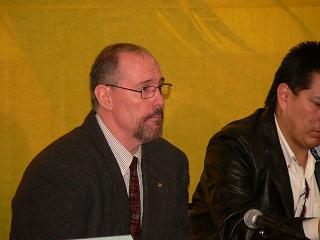
Joe Russell, Montana Board of Environmental Review Chairman
Jonathon Windy Boy, Montana State Representative Another gentleman spoke, stating that the mining companies need to do what needs to be done. "Water is of the highest importance out west, and our population in this region continues to expand even though the water is running out." The thing to do was take care of it in the beginning, but that wasn’t done voluntarily, and now must be done. "This rule may outlaw or kill some mines, but we need to conserve more." Kenneth Halgeson stated that even after the millions spent, "It is worse than before…. The mining industry managed to further their interest, and nothing can get accomplished at a grass-roots level due to lawyers, bureaucracies and big money." Catherine Halver vice president of Island Mountain Protectors and a resident of the area, stated "Pegasus told us nothing about long-term consequences because they didn’t know…. Every time it rains or wind blows, the pollution comes to our reservation…. They went bankrupt and left, and now we are holding the bag." She described the toxic appearance of the water, and explained its effects on the animals, the land and the people, then asked the board members, "Would you want to drink that? We are expected to." In conclusion, Halver declared, "I know we have to have gold, but mining companies need to spend the money and use the technology to clean it up for us and for our grandchildren." Many others spoke about the mountains themselves and how sacred they were to the tribes. For generations, said John Allen, Tribal Council Member, the Fur Cap (Little Rocky) Mountains had been a source of food, shelter, spiritual renewal, medicine and many other necessities, even into modern times. Now, there is little else than rubble, poison and death. This result was made worse by a lack of reclamation plan when Pegasus began operations and the fact that operations continued in the face of obvious problems, such as visible pollution, leaking cyanide, contamination and cyanide coming out the water taps of residential areas. Speakers stressed that "While the mountains can’t be returned, the water must be taken care of." Allen underscored this point by stating that "Water is the blood of Mother Earth, and we must protect the environment for future generations." He also referenced Article 9 of the Montana State Constitution, which provides for environmental protection for future generations, including reclamation. He reminded the board that 10 of 13 mines in Montana require water treatment and that this is an issue spanning the state. The man who probably said the most powerful words at the hearing said them in a soft voice. James Main, Sr., who identified himself as a member of the White Clay Nation, reminded the board that this is nothing new. "The government has taken everything, going back to 1855 at Judith Landing. Before then, we could go where we wanted, do what we wanted, eat and drink what we wanted, but in 1855, they got their foot in the door. Over the years, they took our buffalo, and then came after the land. In 1895, they got their way…. it’s the same old thing. They stole our gold for a number of years, and then sent crooks to do it legally. They wanted it, they took it; they passed laws to cram it down our throats." Main reminded the board that the mountains used to be a haven for wildlife. "Now, you never see them. Deer, blue grouse…. I don’t even want to go up there anymore. They can’t put the mountains back where they were."
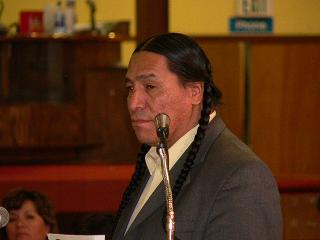
James Main, Sr. He continued, stating that these issues need to be brought up. "They at least owe us good water; water is supposed to be life but the stuff coming out of there and running into our mountains isn’t life…. The cost to treat this water is a drop in the bucket compared to what they took out of the land." The result of this hearing was that the board agreed to extend the comment period to March 17th; it also agreed to consider changes in the language of the rule. The ultimate questions, however, remained unanswered: When will the waters run clear again, and who will pay for it? Edited by TasunkaWitko |
||||||
|
TasunkaWitko - Chinook, Montana
 Helfen, Wehren, Heilen Die Wahrheit wird euch frei machen |
||||||
 |
||||||
|
wildbill69
.30/06 SpringField 

Joined: 11 September 2005 Location: United States Status: Offline Points: 446 |
Post Options
Thanks(0)
Quote Reply
Posted: 17 January 2006 at 17:09 |
|||||
|
It's a shame whem stuff like this is done to the land. Just isn't right.
Bill |
||||||
|
Never Retreat...Just Reload.
Admin - www.handloadersbench.com |
||||||
|
||||||
|
Dave Skinner
.416 Rigby
AKA "Fast Eddie" Joined: 13 June 2003 Location: Albania Status: Offline Points: 1693 |
Post Options
Thanks(0)
Quote Reply
Posted: 17 January 2006 at 17:54 |
|||||
|
I'm not impressed with the ARD in the stream. That is on the scale of
Silver Bow and the mines in Idaho. Should make the board of directors
and stockholders drink the stuff for a year.
While I must raise eyebrows at some of the descriptive language, Ron, I think you did all right for such a complex story. I can imagine it was not an option to find any of Pegasus's  managers before deadline for attribution. managers before deadline for attribution.However, I will have to look at the DEQ board proposal. From what I know of certain members, I would expect the proposal goes beyond actually addressing the issue into Prohibition. |
||||||
|
Up hills slow, down hills fast, tonnage first and safety last
|
||||||
|
||||||
|
TasunkaWitko
Administrator
aka The Gipper Joined: 10 June 2003 Location: Chinook Montana Status: Offline Points: 14753 |
Post Options
Thanks(0)
Quote Reply
Posted: 18 January 2006 at 03:26 |
|||||
|
dave, there's a lot of info that i didn't have time to look at, but strangely, there ws virtually none at all from the "mining" side. in effect. this was a very one-sided story, but at the same time, i guess that there's no real way to justify the mess. i've got quite a bit of stuff, if you need copies, contact me, or for more detail, give dean stiffarm a call. |
||||||
|
TasunkaWitko - Chinook, Montana
Helfen, Wehren, Heilen Die Wahrheit wird euch frei machen |
||||||
|
||||||
|
TasunkaWitko
Administrator
aka The Gipper Joined: 10 June 2003 Location: Chinook Montana Status: Offline Points: 14753 |
Post Options
Thanks(0)
Quote Reply
Posted: 19 January 2006 at 15:00 |
|||||
|
more on this issue, from 1997 and 1998. i haven't read it all in-depth, but it shows that this has been anissue for quite a while. ------------------------------------------------------------ ------
------------------------------------------------------------ --
Edited by TasunkaWitko |
||||||
|
TasunkaWitko - Chinook, Montana
Helfen, Wehren, Heilen Die Wahrheit wird euch frei machen |
||||||
|
||||||
|
TasunkaWitko
Administrator
aka The Gipper Joined: 10 June 2003 Location: Chinook Montana Status: Offline Points: 14753 |
Post Options
Thanks(0)
Quote Reply
Posted: 23 January 2006 at 10:15 |
|||||
|
Facts On The Proposed Rule Banning Perpetual Water Pollution
From the Montana Environmental Information Center Introduction The biggest problem with Montana’s hard rock mines is not getting the reclamation work done (although that is a problem), it’s financing and dealing with long term water quality issues after the mines have closed. So far, Montana is addressing post-mining water quality issues through water treatment (where money exists for the treatment) and discharging the water into nearby streams. Often times this water treatment is expected to last in perpetuity. Unfortunately, every major mine has developed longer term and more severe water problems than originally anticipated. The Zortman and Landusky mines (as well as the Beal Mountain, Basin Creek, and Golden Sunlight mines) will all require water treatment in perpetuity, much longer than anticipated when the mines opened. Montana needs to change its permitting scheme for metal mines. Water quality issues need to be addressed from the outset rather than mitigated after the fact. The Rule MEIC and the Fort Belknap Indian Community Council are asking Montana’s Board of Environmental Review (the Board) to adopt a new rule for permitting metal mines. The rule says: ARM 17.24.116 is amended to read: The reclamation plan must conclusively demonstrate that, after the period of time allotted by MCA 82-4-336(3), no treatment of surface or ground water for carcinogens or toxins will be required to meet water quality standards at the point of discharge. For the purposes of the subsection, completion of mining operations is defined in 17.24.150(1) and (2). To put it another way: a company can’t get a new mining permit unless it shows that water treatment won’t be necessary after it is done reclaiming the mine. Two issues arise from this language. First, when do “mining operations” cease? Fortunately, that issue has already been solved and ARM 17.24.150(1) and (2) give a good definition. The second issue is, what is “water treatment?” The intent is that water coming from the mine site would not need to be altered physically or chemically in order to meet water quality standards. The Argument As already mentioned, every major mine in Montana, whether operating or closed, experiences major water quality problems. Most of these problems will result in the need for water treatment in perpetuity. Why have these problems occurred? Largely because of the types of mines that exist and the method of mining they use. Most of the ore bodies in Montana mines are sulfide bearing. This means that when the ore is exposed to water and air it produces acid. The acid in turn leaches through the rock, extracting other metals, and becomes acid mine drainage. This is the problem at Zortman and Landusky, as well as at Beal Mountain and Golden Sunlight. The other reason for the current problems is a lack of understanding about the hydrology and chemistry of the mines. Open-pit, cyanide leaching is a relatively new method of mining. It was initially permitted in Montana at the Zortman and Landusky mines. These and other mines using open pit, cyanide leaching are essentially massive, long-term chemistry and hydrology experiments. As yet, we don’t really know how the experiment will turn out. Other mines that don’t have open pits or that use an ore extraction method other than cyanide leaching have problems as well. So, if mines continue to cause water quality problems and some of the problems are going to exist in perpetuity, we need to do something about it. Montana should not permit any new mines unless the operator can demonstrate, before mining, that no water quality problems will occur and water treatment won’t be necessary once the mine is closed. The Goal MEIC hopes that the board will adopt this rule or something very similar. Only then will the mining industry have to change its practices and begin operating in a responsible, protective manner and keep our water clean. Edited by TasunkaWitko |
||||||
|
TasunkaWitko - Chinook, Montana
Helfen, Wehren, Heilen Die Wahrheit wird euch frei machen |
||||||
|
||||||
|
Muleskinner
.416 Rigby

AKA The Crotchety ol’ Geezer Joined: 13 June 2003 Location: United States Status: Offline Points: 5285 |
Post Options
Thanks(0)
Quote Reply
Posted: 26 January 2006 at 07:53 |
|||||
|
You're putting this on a forum where a member recently called Aldo Leopold, the father of modern conservation, a dipshit? Love to see the credentials of those with such radical non-viewpoints (can't really call them viewpoints since they are so short-sighted and founded on ignorance). Anyhoo, I been spoutin' off 'bout acid mine drainage fer years, and always to a chorus of "who cares." I reckin' thet's the real problem, now ain't it? Edited by Muleskinner |
||||||
|
Mule
|
||||||
|
||||||
|
Post Reply
|
|
 Tweet
Tweet
|
| Forum Jump | Forum Permissions You cannot post new topics in this forum You cannot reply to topics in this forum You cannot delete your posts in this forum You cannot edit your posts in this forum You cannot create polls in this forum You cannot vote in polls in this forum |


 Topic Options